_fbeta HDDT-Gateway
Background
The German government has a continous effort to improve digital and hybrid care for patients in the public health system. § 374a SGB V aims to improve healthcare offers of DiGA, by making it easier for DiGA to access electronic patient data from medical aids and implants.
Example use cases
The measures planned by § 374a SGB V could enhance multiple healthcare use cases, such as:
- Telemonitoring via a DiGA – For example, in the context of a disease management program (DMP), a patient’s chronic condition could be monitored and supported by integrating data measured by implants with patient‑reported outcome measures (PROMs).
- AI-based analysis of a patient’s condition – DiGA could use data from electronic medical devices to support AI-based analysis of a patient’s condition, resulting in therapy recommendations and adjustments, and helping patients better manage their own health.
- Providing medical device data directly to healthcare providers – Data can be transferred via ePA or KIM, used to generate standardized reports (e.g. an ambulatory glucose profile), and trigger notifications to healthcare providers once thresholds are exceeded.
- Boosting the positive effect of DiGA – For example, by automatically recording data from medical devices instead of requiring patients to enter it manually, and by enabling the use of a medical device of the patient’s choice.
Who is impacted?
The regulation impacts manufacturers of medical aids and implants, who
- provide devices which are reimbursed by statutory health insurance, and
- provide apps to patients for visualizing device data and/or configuring the device, and
- run backend services that process the measured data.
These manufacturers are required to provide the processed data (including aggregated data), to the extent that such data is required by a DiGA for the intended use by the same insured person.
The data must be provided to DiGA in interoperable data formats. Consequently, manufacturers of medical aids and implants must offer interoperable interfaces through which DiGA can access electronic patient data. The medical aids and interfaces must also be entered into an electronic registry provided by BfArM.
What is HDDT?
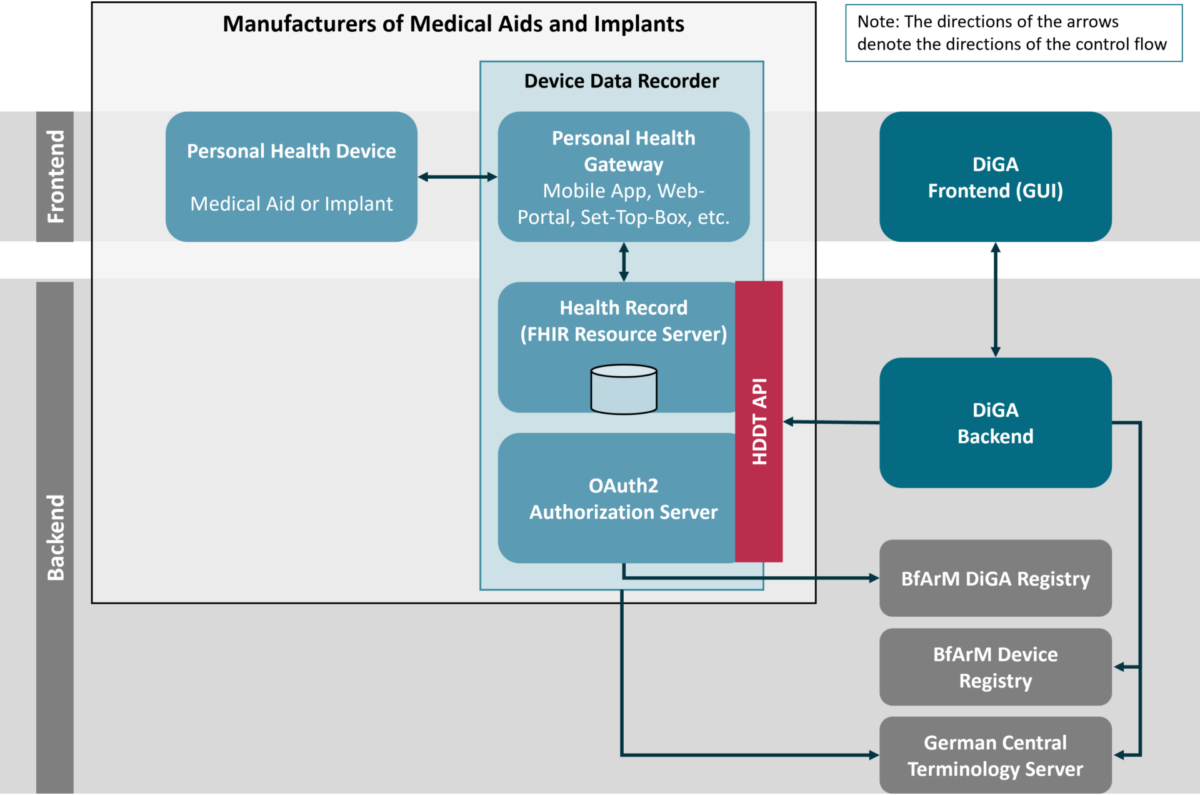
HDDT (Health Device Data Transfer) is a technical specification published by gematik. It defines the normative requirements that a medical aid manufacturer must implement in order to comply with § 374a SGB V.
Mandatory Interoperable Values (MIVs)
The specification is centered around Mandatory Interoperable Values (MIVs). During the creation of the specification, a thorough analysis was conducted to identify which types of data should initially be required for transfer from medical aid manufacturers to DiGA. The analysis focused on medical domains with a high number of prescriptions for electronic medical aids and implants, and then examined common use cases within each domain to understand:
- in which constellations devices are used,
- what data is transferred, and
- how this data is used and medically interpreted.
Collections of measured values that represent a common use case were grouped under the same MIV.
Currently, the specification defines four MIVs, with more expected in the future:
- Blood Glucose Monitoring
- Continuous Glucose Monitoring
- Lung Function Testing
- Blood Pressure Monitoring
Manufacturers of electronic medical aids and implants that measure any of these MIVs are required to implement and operate the interface in order to make the measurements available to DiGA.
Pairing
The HDDT specification also defines a comprehensive pairing procedure, which serves the following purposes:
- It ensures secure communication between the DiGA and the medical aid manufacturer’s interface.
- It produces a Pairing ID, which ensures that the DiGA and the medical aid manufacturer “agree” that they are exchanging data for the same patient, without revealing the patient’s identity to either party.
- It ensures that the patient’s consent regarding which data the DiGA is allowed to access is properly recorded
FHIR Interface
The HDDT specification relies on the HL7 FHIR standard for interoperability. It defines normative requirements for a REST FHIR API, through which DiGA can access patient data from medical aids and implants. In addition, each MIV defines a set of FHIR profiles that specify how the data must be structured in order to be transferred to DiGA. Medical aid manufacturers must provide the data in this format, and DiGA must be able to interpret it.
The specification also includes additional requirements for security (e.g. usage of mutual TLS), error handling, and operation (e.g. availability, logging, and the provision of a test environment, etc.) of the interface.
How fbeta supports this process
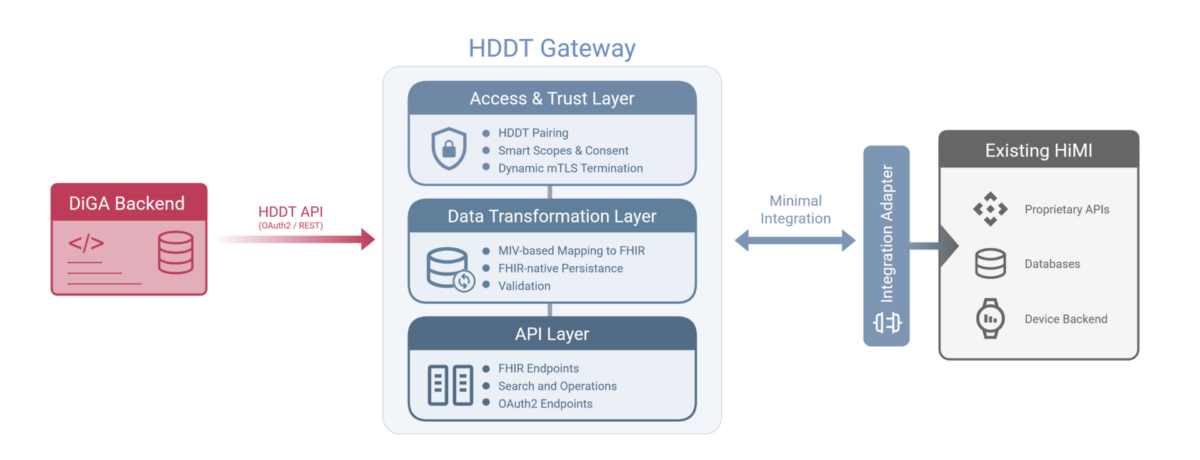
_fbeta offers a HDDT Gateway – a collection of infrastructure components designed to minimize the complexity of implementing the HDDT interface and its regulatory requirements. The HDDT Gateway provides the following functionality:
- Management of mTLS connectiviti with eligible DiGA
- An authorization server that implements the HDDT pairing procedure and manages SMART OAuth scopes based on patient consent
- A FHIR server that supports all endpoints, search parameters, and operations required for a particular MIV, and that includes authorization rules to ensure data access is aligned with the SMART scopes
- FHIR-native storage and validation, ensuring data correctness and reducing overhead during data transfer
- An integration adapter that minimizes integration effort by transforming data from existing databases, APIs, and proprietary formats into the FHIR resources required by HDDT
In addition, _fbeta offers an Onboarding Portal for manufacturers of medical aids, which can be integrated with the HDDT Gateway to provide a test environment for DiGA. It includes:
- Creation or upload of mTLS certificates for DiGA
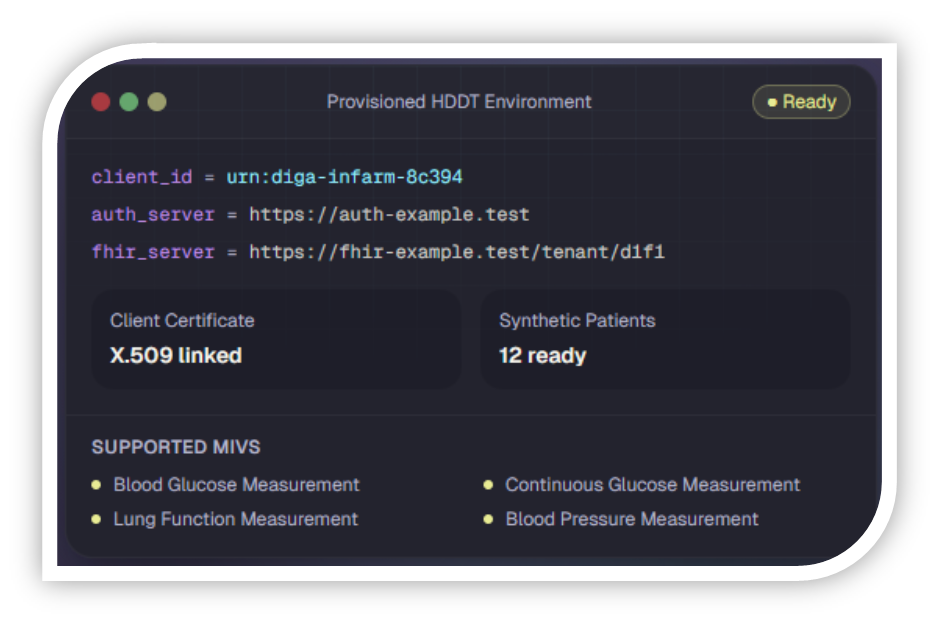
- Automatic provisioning of a private test environment
- Automatic generation of test data (patients, measurements) for every MIV defined by HDDT
- A graphical user interface that allows all of the above features to be managed with just a few clicks